AI Content

Creating an LLM-friendly content structure means organizing your website so AI language models like ChatGPT, Gemini, and Claude can easily understand and retrieve your information. This involves using clear hierarchical headings, structured data markup, concise answers to common questions, and semantic HTML that helps AI assistants accurately cite your business when users ask relevant questions. For businesses competing in today’s digital marketplace, optimizing content structure for large language models has become essential for visibility in AI-powered search results that are rapidly transforming how customers discover products and services.
The digital landscape has transformed dramatically. When potential customers ask ChatGPT or Google’s AI Overviews about products or services in your industry, will your business appear in the response? For companies worldwide competing in an increasingly AI-driven search environment, the answer depends on how well your website content is structured for large language models.
Traditional SEO focused on pleasing Google’s algorithms. Today’s reality demands a dual approach: satisfying both conventional search engines and the AI assistants that millions of users now trust for recommendations and information. At Rankedge AI, we’ve helped businesses globally restructure their digital content to capture visibility across both traditional and AI-powered search platforms.
LLM-friendly content structure refers to organizing your website information in ways that large language models can easily parse, understand, and retrieve when generating responses to user queries. Unlike traditional SEO that is optimized for keyword rankings, AI search optimization ensures your content can be accurately interpreted and cited by conversational AI systems.
Think of it this way: when someone asks an AI assistant “What’s the best accounting software for small businesses?” The AI needs to quickly identify, extract, and synthesize relevant information from websites across the internet. Sites with clear, structured content get cited. Sites with poorly organized information get ignored.
The shift is significant. According to recent industry research, over 40% of internet users now turn to AI chatbots for initial product research before making purchase decisions. If your content isn’t structured for AI retrieval, you’re invisible to a massive and growing segment of potential customers.
Large language models process information differently than traditional search engines. While Google crawls pages and indexes keywords, LLMs analyze semantic meaning, context, and relationships between ideas. They look for clear answers to specific questions, coherent explanations of complex topics, and authoritative information presented in logical sequences.
When your content structure aligns with how LLMs process information, several benefits emerge:
Enhanced visibility in AI responses: Well-structured content increases the likelihood that AI assistants will cite your business when answering relevant queries.
Improved accuracy of citations: Clear headings and concise sections help LLMs extract correct information without misrepresenting your services or products.
Competitive advantage: Most businesses haven’t yet optimized for AI search, creating significant opportunities for early adopters.
Sustained traditional SEO performance: Content structured for LLMs typically performs well in conventional search engines too, since both prioritize user experience and clear information architecture.
Understanding the technical process helps clarify why structure matters. When an LLM encounters your website, it doesn’t simply read text like a human would. The model tokenizes content, analyzes semantic relationships, identifies entity mentions, and maps information into multi-dimensional vector spaces that enable rapid retrieval.
Clear structural signals—headings, lists, schema markup, logical flow—act as guideposts that help LLMs navigate and categorize your content. Ambiguous structure forces the AI to guess at meaning and relationships, often resulting in your content being overlooked or misinterpreted.
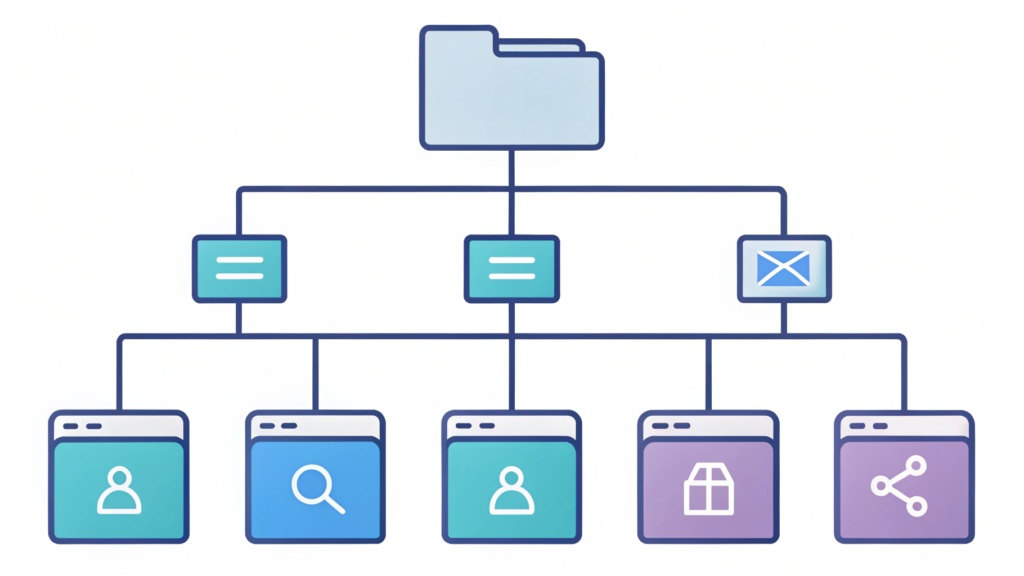
Think of your content structure as a filing system. A well-organized filing cabinet allows anyone to quickly find what they need. A pile of unsorted documents makes retrieval nearly impossible, even if valuable information exists somewhere in the stack.
Creating content that AI assistants can effectively process requires attention to several key structural elements. Let’s explore each component and understand how it contributes to AI visibility.
Your heading hierarchy (H1, H2, H3) serves as the primary navigation system for both human readers and AI models. The H1 should clearly state your page topic, while H2 and H3 headings break content into logical sections and subsections.
Effective heading structure for AI optimization:
Poor example: “Services” → “What We Do” → “Learn More”
Strong example: “AI SEO Services for Modern Businesses” → “How Does AI Search Optimization Work?” → “Benefits of Structured Content for LLMs”
The difference is clarity and specificity. AI models trained on vast amounts of structured data respond well to explicit, descriptive headings that signal content relevance.
AI assistants primarily respond to questions. When users interact with ChatGPT or similar tools, they typically ask conversational queries: “How do I optimize my website for AI search?” or “What makes content LLM-friendly?”
Structuring sections of your content around these natural questions dramatically improves AI retrieval. By anticipating user queries and providing direct, concise answers, you position your content as the ideal source for LLMs to cite.
This approach aligns perfectly with how conversational AI works, processing natural language queries and matching them with relevant information structured as clear question-answer pairs.
Consider organizing major sections around questions like:
Follow each question with a concise, direct answer in the first 2-3 sentences, then elaborate with supporting details, examples, and evidence.
LLMs process information more effectively when paragraphs are concise and focused on single ideas. Long, dense blocks of text make it difficult for AI models to extract specific information accurately.
Best practices for paragraph structure:
This approach benefits human readers too. Scannable content with clear information hierarchy performs better across all channels—traditional search, social media, and AI-powered platforms.
Lists provide excellent structure for AI processing. They clearly delineate separate items, making it easy for LLMs to extract and reference specific points without confusion.
When to use lists in LLM-friendly content:
Introduce lists with clear context sentences that explain what the list contains. This helps both human readers and AI models understand the purpose and content of the list before processing individual items.
While schema markup primarily benefits traditional SEO, it also provides valuable signals to AI systems. Structured data explicitly identifies entities, relationships, and attributes within your content, reducing ambiguity for machine processing.
Relevant schema types for business websites include:
Implementing schema markup requires some technical knowledge, but the investment pays dividends in both traditional search visibility and AI citation accuracy. Many content management systems offer plugins that simplify schema implementation.
Most businesses already have substantial website content. Rather than starting from scratch, you can optimize existing pages to improve AI visibility.
Start with a content audit. Identify your most important pages—those targeting valuable keywords, generating significant traffic, or covering core service offerings. These pages warrant priority attention for LLM optimization.
For each priority page, evaluate current structure against LLM-friendly principles:
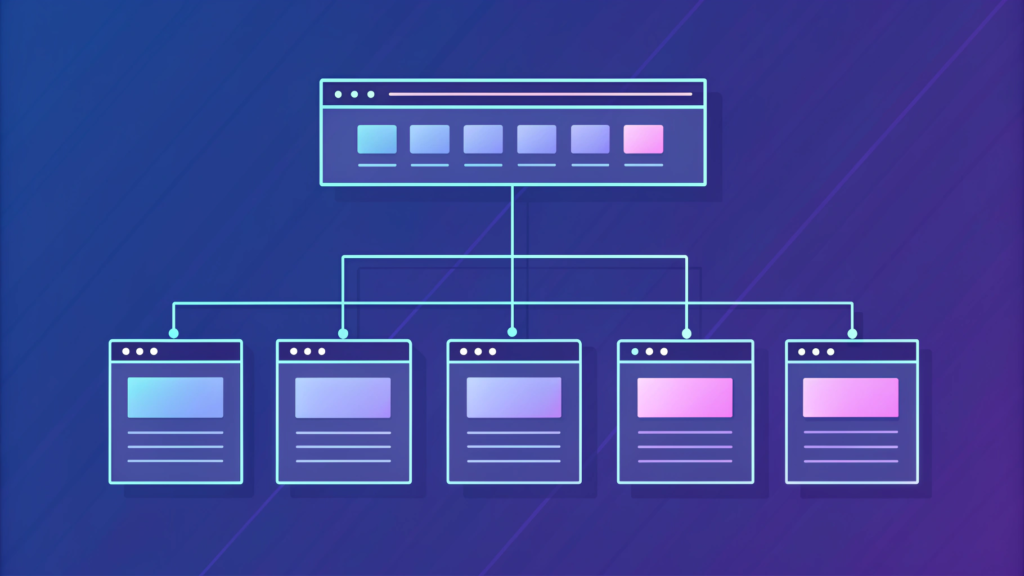
Heading hierarchy: Does the page use clear, descriptive H2 and H3 headings that break content into logical sections? Are any sections too long or poorly organized?
Question-based organization: Could any sections be reformatted around natural language questions? Are there opportunities to add FAQ-style content?
Paragraph length: Are paragraphs concise and focused? Do they start with main points followed by supporting details?
Information density: Is the content scannable, or does it require deep reading to extract key points? Would lists or bullets improve clarity?
Schema markup: Is appropriate structured data implemented? Are there opportunities to add product, FAQ, or how-to schema?
Make incremental improvements over time. You don’t need to restructure every page immediately. Focus on high-value content first, then gradually optimize secondary pages as resources allow.
Beyond visible content structure, the underlying HTML markup significantly affects how AI models interpret your pages. Semantic HTML uses tags that convey meaning about content, not just appearance.
Semantic HTML elements important for AI processing:
Article tags (<article>) identify self-contained content pieces like blog posts or product descriptions.
Section tags (<section>) group related content under thematic headings.
Header tags (<header>) designate introductory content or navigation.
Nav tags (<nav>) identify primary navigation menus.
Aside tags (<aside>) mark supplementary content like sidebars or related links.
Figure and figcaption tags (<figure>, <figcaption>) associate images with descriptive captions.
Using semantic HTML helps AI models understand content structure and relationships even when visual presentation doesn’t make these clear. It’s like providing a detailed map alongside your content that shows how everything connects.
Many websites use generic <div> tags for all structural elements. While this doesn’t prevent AI processing, it removes valuable signals that could improve accuracy and relevance assessment.
Integrating RAG-Friendly Content Strategies
Modern AI search increasingly relies on Retrieval-Augmented Generation (RAG), a technique where AI systems first retrieve relevant information from external sources, then use that information to generate responses. Understanding what is retrieval-augmented generation helps you structure content that performs well in RAG-based AI systems.
RAG-optimized content includes:
Clear source attribution: When citing statistics, research, or expert opinions, clearly identify sources. This helps AI systems assess credibility and appropriately attribute information.
Self-contained sections: Each major section should make sense independently, since RAG systems often extract specific sections rather than entire pages. Avoid excessive cross-references that require reading other sections for context.
Explicit definitions: Define technical terms and industry jargon when first used. Don’t assume AI models have full context about your specific industry or niche.
Date stamps on time-sensitive information: Clearly indicate when information was published or last updated, especially for data, statistics, or recommendations that may change over time.
These practices align with how AI assistants retrieve and present information to users, increasing the likelihood that your content will be selected and accurately represented in AI-generated responses.
Understanding what not to do is as important as knowing best practices. Several common structural mistakes significantly reduce AI visibility and citation accuracy.
Keyword stuffing: While traditional SEO often involved heavy keyword repetition, modern AI search penalizes unnatural language. LLMs trained on high-quality text recognize and deprioritize content that reads awkwardly or repeats phrases unnaturally. Focus on clear communication over keyword density.
Orphaned content: Pages with little internal linking or contextual connection to your site’s broader topic structure confuse AI models trying to understand your domain expertise. Every page should connect logically to related content through internal links and consistent topical focus.
Ambiguous pronouns and references: Writing “it helps businesses improve results” without clearly specifying what “it” refers to creates confusion for AI processing. Always use specific nouns rather than vague pronouns, especially when introducing new concepts or solutions.
Hidden or dynamically loaded content: Information that appears only after user interaction (clicking tabs, expanding accordions, scrolling) may not be processed by some AI systems. Critical information should be visible in the initial page HTML, not loaded through JavaScript.
Inconsistent terminology: Using multiple terms for the same concept (“AI search,” “LLM optimization,” “chatbot SEO”) without establishing that they’re related makes it harder for AI models to recognize your comprehensive coverage of a topic. Introduce variations but maintain primary terminology throughout.
AI models assess topic authority based on comprehensive coverage across related content. Creating content clusters—groups of interlinked pages covering different aspects of a core topic—signals deep expertise that LLMs recognize and reward.
A content cluster structure includes:
Pillar content: A comprehensive overview page covering your core topic at a high level. This becomes your authoritative resource that links to more specific subtopic pages.
Cluster content: Detailed pages exploring specific aspects of your core topic in depth. Each cluster page links back to the pillar content and to related cluster pages.
Strategic internal linking: Clear connections between related pages that help both human readers and AI models navigate your topic coverage.
For example, a pillar page about “AI-Powered Marketing Strategies” might link to cluster pages covering “AI Content Creation Tools,” “Predictive Analytics for Customer Behavior,” “Chatbot Implementation for Lead Generation,” and “Automated Email Personalization.”
This structure demonstrates comprehensive topic knowledge that AI assistants can draw from when generating responses. Instead of citing one page, the AI might reference multiple pages from your cluster, significantly increasing your overall visibility.
Measuring AI Search Performance
Traditional SEO metrics focus on rankings, traffic, and conversions from search engines. Measuring AI search performance requires different approaches since AI-generated responses don’t always drive direct website traffic.
Key indicators of AI search success:
Brand mentions in AI responses: Manually test relevant queries in ChatGPT, Claude, Perplexity, and other AI assistants. How often does your business appear in responses?
Citation frequency: When your business is mentioned, is it cited as a primary source or mentioned alongside competitors? Quality of citations matters as much as quantity.
Accuracy of information: Do AI assistants correctly represent your services, products, and expertise? Misrepresentation suggests structural issues that need addressing.
Direct traffic patterns: Monitor direct and referral traffic that doesn’t come from traditional search engines. Spikes might indicate users finding your business through AI assistants, then visiting directly.
Branded search volume: Increases in people specifically searching for your business name suggest they’ve discovered you through alternative channels, potentially including AI search.
Measuring AI search visibility remains an evolving challenge. As these platforms mature, they’ll likely provide analytics similar to traditional search console data. For now, manual monitoring and indirect indicators offer the best insights.
Restructuring content for LLM optimization requires technical knowledge, strategic planning, and ongoing adjustment as AI search evolves. Many businesses benefit from partnering with specialists who stay current with AI search developments and proven optimization strategies.
Rankedge AI specializes in helping businesses transition from traditional SEO to comprehensive AI search optimization. Our approach combines technical implementation, content strategy, and performance monitoring to ensure your website maintains visibility across both conventional and AI-powered search platforms.
We work collaboratively with clients to understand business goals, audit existing content, identify optimization opportunities, and implement structural improvements that enhance AI visibility while maintaining traditional search performance. Our proven methodologies and focus on measurable results have helped businesses across diverse industries adapt to the changing search landscape.
Whether you’re starting from scratch or optimizing existing content, AI SEO services can accelerate your progress and ensure implementation aligns with current best practices and emerging trends.
Future-Proofing Your Content Structure
AI search continues evolving rapidly. What works today might need adjustment tomorrow as new models launch and search behaviors change. Building flexibility into your content structure helps ensure longevity.
Future-proofing strategies:
Modular content design: Structure content in self-contained modules that can be easily reorganized, updated, or repurposed as needs change.
Regular content audits: Schedule quarterly reviews of top-performing pages to identify optimization opportunities and address emerging issues.
Monitor AI search trends: Stay informed about new AI platforms, changing user behaviors, and algorithm updates that affect visibility.
Maintain content freshness: Regularly update statistics, examples, and recommendations to ensure information remains current and accurate.
Document your structure: Keep clear records of your content organization, internal linking strategy, and optimization decisions to inform future updates.
The businesses that thrive in AI-powered search will be those that view content structure as an ongoing priority rather than a one-time project. Regular attention to how AI models interact with your content keeps you ahead of competitors who treat it as a set-and-forget task.
Creating an LLM-friendly content structure isn’t optional anymore—it’s essential for modern digital visibility. As AI assistants become the primary way people discover products, services, and information, businesses that optimize for AI search gain significant competitive advantages.
The process begins with understanding how AI models process information, then systematically restructuring your content to align with those processing patterns. Clear headings, question-based organization, concise paragraphs, strategic lists, semantic HTML, and comprehensive topic coverage all contribute to improved AI visibility.
Don’t let your business become invisible in the AI search revolution. Contact Rankedge AI today to schedule your complimentary website audit and AI search optimization consultation. Our team will analyze your current content structure, identify specific opportunities for improvement, and provide a customized roadmap for capturing visibility in both traditional and AI-powered search.
The future of search is here. Make sure your business is part of it.
Traditional SEO focuses on ranking high in search engine results pages through keyword optimization, backlinks, and technical factors like site speed. AI search optimization focuses on structuring content so language models can accurately understand, extract, and cite your information when generating responses to user queries. While traditional SEO targets visibility in ranked lists, AI optimization targets inclusion in conversational AI responses. Both approaches complement each other, and the best strategy incorporates elements of both.
Results vary based on your starting point and implementation scope, but most businesses begin seeing improved AI citations within 2-3 months of implementing structural optimizations. Unlike traditional SEO where algorithm updates can take weeks to reflect changes, AI models often incorporate newly structured content more quickly. However, building comprehensive topic authority through content clusters may take 6-12 months of consistent effort. The key is starting now, as early adopters gain significant advantages while competitors lag behind.
Absolutely. LLM-friendly content structure generally improves traditional search performance because both prioritize clear information architecture, user experience, and high-quality content. The organizational principles that help AI models process content—clear headings, concise paragraphs, logical flow—also benefit human readers and traditional search algorithms. In fact, Google’s own AI Overviews feature relies on content structured similarly to what independent AI assistants prefer, making optimization for one beneficial for the other.
Basic LLM optimization—improving headings, reorganizing content around questions, writing concise paragraphs—requires no technical expertise. These are editorial improvements any content creator can implement. Advanced optimizations like schema markup, semantic HTML, and RAG-specific structuring may benefit from technical knowledge or specialist assistance. Most businesses can handle foundational improvements internally while partnering with AI SEO specialists for technical implementation.
Conduct major content audits quarterly to identify pages needing optimization and assess performance of previous improvements. For individual pages, review and update time-sensitive information (statistics, examples, recommendations) every 6-12 months. Monitor AI search trends monthly to stay aware of platform changes that might require structural adjustments. Unlike traditional SEO where constant tweaking can be counterproductive, AI search optimization benefits from regular attention and incremental improvements as the technology and user behaviors evolve.
What Next
Tell us what you are trying to grow and we will tell you honestly whether we are the right people for it.