SEO Tips & Strategies
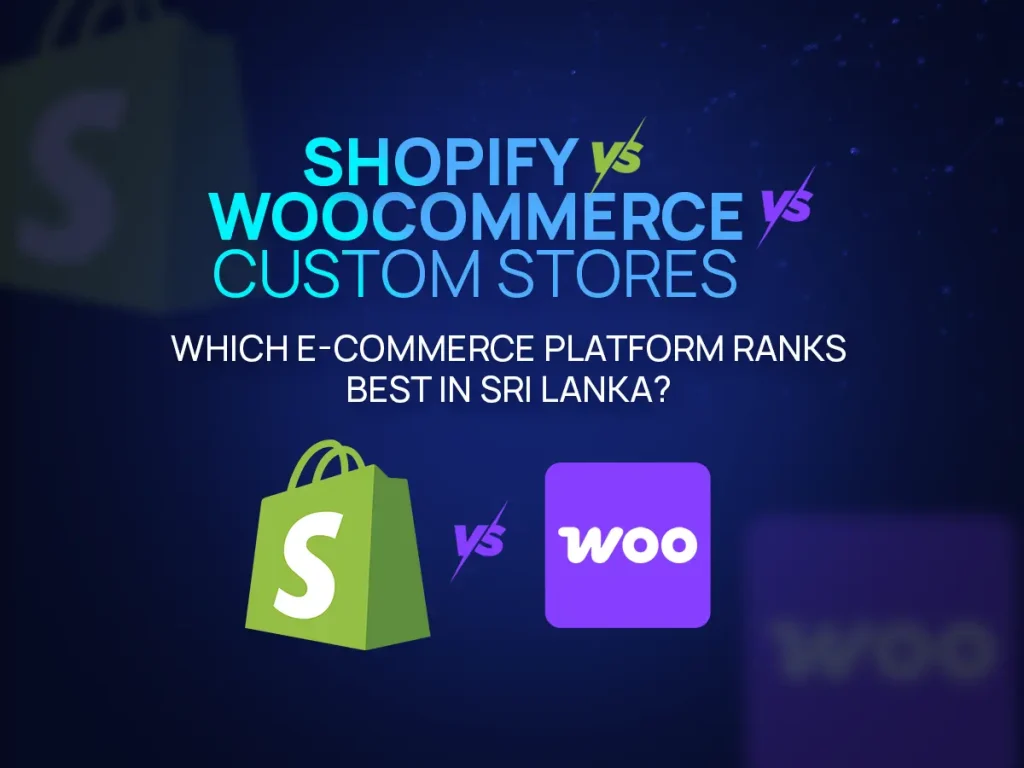
No e-commerce platform ranks better on Google by itself. Shopify gives Sri Lankan sellers the fastest route to a clean, technically sound store with little maintenance. WooCommerce offers the deepest SEO and content control for brands that publish often and want full ownership. A custom-built store can outperform both, but only when SEO is planned into the build from day one. The best ecommerce platform in Sri Lanka is the one that matches your catalogue size, budget, team skills and target markets.
If you are weighing up Shopify vs WooCommerce in Sri Lanka, or wondering whether a custom-built store is worth the extra investment, you are asking the right question at the right time. More Sri Lankan brands now sell online to local shoppers and to buyers in Australia, the UK, Europe and the Middle East. The platform you choose quietly shapes how easily Google, and now AI assistants like ChatGPT and Gemini, can find and recommend your products.
Here is the honest truth: every platform can rank. What changes is how much control you get, how much work it takes, and where the ceiling sits as you grow. In this guide, we compare all three options through an SEO lens, add the local realities that global comparisons skip (payment gateways, rupee budgets, multilingual content), and finish with a simple way to decide.
What you will learn:
Your e-commerce platform affects rankings because it controls the technical foundations search engines rely on: URL structure, page speed, structured data, crawlability and how easily you can publish content. A platform cannot rank a store on its own, but a poor fit can cap your growth or create problems that take months to fix.
In practice, your platform decides how much control you have over five things:
Think of your platform as the foundation of a house. You can redecorate any time, but moving the foundations later is slow, risky and expensive.
Both platforms can rank on page one. As Centric’s ecommerce SEO team explains, the real trade-off is a managed baseline that is hard to break versus full control that is easier to misconfigure. Custom stores sit at the far end of that scale: total freedom, total responsibility.
| SEO factor | Shopify | WooCommerce | Custom store |
|---|---|---|---|
| Setup speed | Fastest, fully hosted | Moderate, needs hosting and plugins | Slowest, built from scratch |
| URL control | Partial, fixed /products/ and /collections/ prefixes | Full | Full |
| Technical SEO tools | Solid built-in basics, apps for more | Deep control via Rank Math or Yoast | Whatever your developers build |
| Page speed | Consistent, managed hosting and CDN | Depends on hosting and build quality | Can be fastest, if engineered well |
| Content and blogging | Basic blog | Full WordPress CMS | Fully custom |
| Structured data | Theme plus apps | Plugins with granular control | Hand-coded |
| Sri Lankan payments | PayHere app available | PayHere plugin available | Custom integration |
| Ongoing maintenance | Low | Medium to high | High |
| Cost profile | Monthly subscription in USD, plus apps | Low software cost; hosting, plugins and developer time | Highest upfront investment |
The short version: Shopify wins on ease and reliability, WooCommerce wins on SEO depth and content, and custom stores win on flexibility, provided the build is done right.
Yes. Shopify is a strong choice for small and mid-sized Sri Lankan stores that want a fast, secure site without managing servers. It handles sitemaps, canonical tags, SSL certificates and mobile-friendly themes automatically. Its main limits are fixed URL prefixes, a fairly basic blog and a reliance on paid apps for advanced SEO.
Good Shopify SEO in Sri Lanka is less about fighting the platform and more about using it well. A seasoned Shopify SEO expert will focus on collection page copy, internal linking, product schema, image compression and keeping the app stack lean.
WooCommerce runs on WordPress, the most flexible content platform on the web, so you control every URL, title, schema type and content layout. That makes it ideal for brands that grow through blogs, buying guides and detailed category pages. The trade-off is responsibility: you manage hosting, updates, security and speed.
For Sri Lankan exporters, spice brands, apparel labels and specialist retailers, that content depth often decides who wins the long-tail searches international buyers actually type.
The best SEO WooCommerce stores share one habit: someone owns the maintenance. Flexibility only pays off when it is looked after.
A custom store makes sense when your business has outgrown templates: complex catalogues, B2B pricing, ERP or POS integrations, multiple markets or a truly unique shopping experience. It gives you unlimited control, but nothing comes built in. Every sitemap, canonical tag, redirect and schema type must be specified and coded.
A custom store is a blank canvas. That is its greatest strength and its biggest SEO risk.
Strong custom website SEO in Sri Lanka starts before the first line of code. We recommend an SEO specification that sits alongside the design brief, covering URL rules, rendering, schema and redirects, so search visibility is engineered in rather than patched on later.
The right platform depends on your team, your catalogue and where your customers are. Team skills matter more than most people expect: Redefine Web notes that a marketing lead without WordPress experience usually runs Shopify better, while a team with a WordPress developer gets more out of WooCommerce.
| If your situation looks like this | Choose |
|---|---|
| You want to launch quickly, have a small team and a modest catalogue | Shopify |
| You sell to overseas buyers and need reliable checkout with minimal upkeep | Shopify |
| Content marketing and long-tail search are central to your growth | WooCommerce |
| You already run a WordPress site or have a developer on hand | WooCommerce |
| You need ERP or POS integration, B2B pricing or complex product logic | Custom store |
| You run multiple brands or markets with very specific requirements | Custom store |
Already on a platform that is working reasonably well? Think carefully before switching. Centric’s advice is a sensible rule of thumb: migrate for business or operational reasons, not for SEO alone. Most ranking problems can be fixed on the platform you already have.
AI assistants such as ChatGPT, Gemini, Perplexity and Google AI Overviews favour pages that are easy to crawl, clearly structured and rich in specific facts. All three platforms can deliver this. What matters is how the store is set up, not the logo on the dashboard.
To make your products easier for AI tools to find and recommend:
Not sure whether to focus on Google’s AI features or ChatGPT first? Our guide on where Sri Lankan businesses should invest in AI optimisation first breaks down the decision.
At Rank Edge, we are platform-agnostic. As an ecommerce SEO agency with offices in Colombo and Melbourne, we optimise Shopify, WooCommerce and custom stores for clients across Sri Lanka, Australia, New Zealand and beyond. Our team brings more than 12 years of SEO experience, including over 7 years with Australian clients.
Our four-step process (Discover, Strategise, Execute, Optimise) combines technical SEO, content and AI search visibility into one plan. The results speak for themselves:
Whether you need SEO services for Shopify, a WooCommerce speed and schema clean-up, or an SEO plan for a custom build, we start with an honest audit of what is holding your store back.
Ready to find out what your store needs to rank? Talk to our ecommerce SEO team and get a clear, practical growth plan for your platform.
For most small businesses, Shopify is easier to get right because hosting, speed and technical basics are handled for you. WooCommerce offers more SEO control and stronger content tools, so it often wins for brands that publish regularly. In the Shopify vs WooCommerce SEO debate, the better choice is the one your team can maintain consistently.
Yes. Sri Lankan gateway PayHere integrates with both platforms, accepting local and international cards plus local digital wallets, with payouts to a Sri Lankan bank account. WooCommerce also includes cash on delivery by default, and Shopify supports it as a manual payment method.
Not if the migration is planned properly. Map every old URL to its new address with 301 redirects, carry over titles, meta descriptions and content, then resubmit your sitemap in Google Search Console. Most ranking losses after a move come from missing redirects, not the new platform.
Most stores see early movement within two to three months, with stronger, compounding gains over six to twelve months. Results depend on competition, your current site health and how consistently you publish and improve content. Paid ads can bring traffic sooner while SEO builds.
Built-in tools cover the basics, but they do not choose keywords, write category copy, fix duplicate URLs or build authority. An experienced ecommerce SEO company turns those tools into a strategy, spotting technical issues early and focusing effort on the pages that drive revenue.
Keep Reading

What Next
Tell us what you are trying to grow and we will tell you honestly whether we are the right people for it.