AI-Powered SEO

Conversational AI systems like ChatGPT, Perplexity, and Google’s AI Overviews process user questions through a sophisticated multi-stage pipeline that transforms natural language queries into accurate, helpful answers. This article explains how conversational AI works, breaking down each stage from the moment you ask a question to when you receive a response. The process involves query processing, embedding conversion, semantic retrieval from vector databases, context assembly, language model generation, and post-processing with citations. Understanding this pipeline is crucial for Sri Lankan businesses because it reveals exactly what AI systems need to find, retrieve, and cite your content when answering customer questions. By optimizing your digital presence to align with each stage of this conversational AI workflow, businesses can dramatically improve their visibility in AI-powered search results and ensure their brand gets mentioned when potential customers ask AI assistants about products, services, or solutions in their industry.
Have you ever wondered what happens in those few seconds between asking ChatGPT a question and receiving a detailed answer? Or why AI sometimes cites certain businesses while completely ignoring others?
For business owners and marketers in Sri Lanka navigating the shift from traditional search to AI-powered discovery, understanding how conversational AI works isn’t just technical curiosity—it’s competitive advantage. When you know exactly how AI processes queries and generates responses, you can optimize your content to appear in those answers.
Let’s walk through the complete journey of a user question, from the moment someone asks an AI assistant something to the final response they receive.
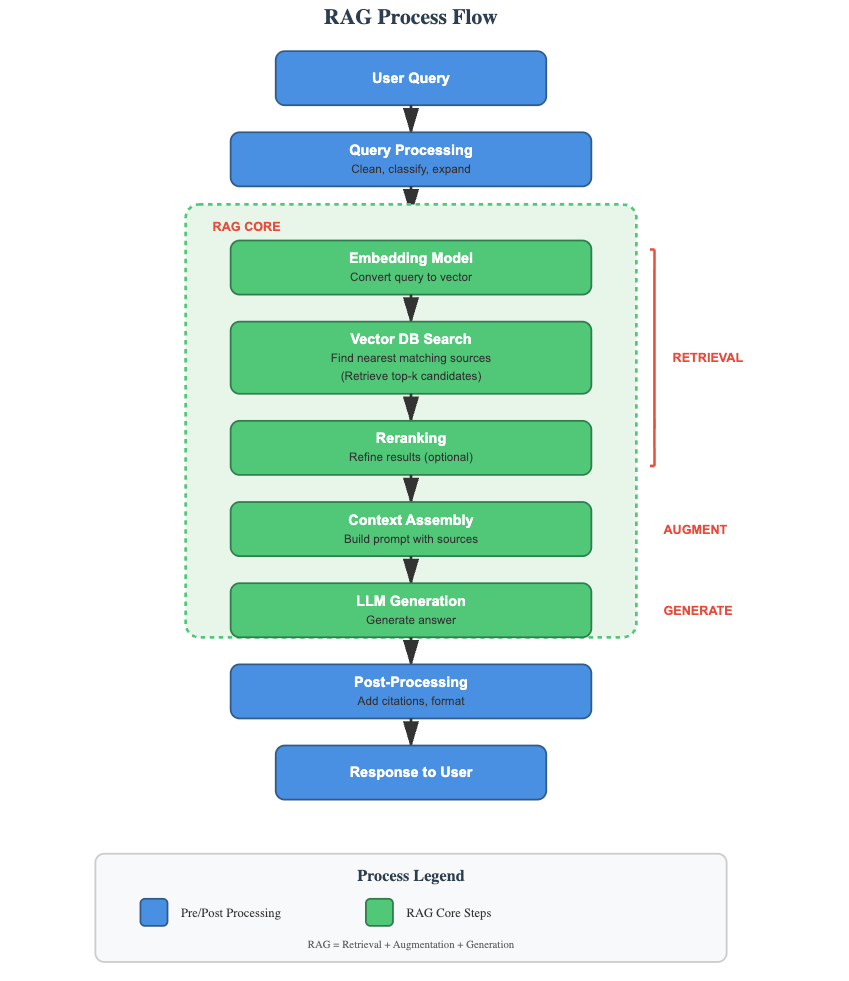
When you type a question into ChatGPT or ask Perplexity for recommendations, your query goes through seven distinct stages before you see an answer:
Each stage plays a critical role in determining whether your business content gets found and cited. Let’s explore what happens at each step.
The moment you enter a question, the AI system doesn’t immediately start searching for answers. First, it needs to understand exactly what you’re asking.
What Happens:
Example for Sri Lankan Businesses:
When someone asks: “best digital marketing agency colombo”
The AI processes this as:
This expansion is why your content doesn’t need to contain exact keyword matches. If you’ve written comprehensively about digital marketing services in Colombo with related terminology, your content becomes retrievable even when users phrase questions differently. Explore more on Query processing in search.
This is where conversational AI gets truly intelligent. Your question isn’t searched for word-by-word—instead, it’s converted into a mathematical representation called a vector that captures the meaning of your query.
What Happens:
The embedding model takes your processed query and converts it into a vector—essentially a long list of numbers that represents the semantic meaning of your question. Similar concepts have similar vectors, which is how AI understands that “SEO agency” and “search optimization company” mean essentially the same thing.
Think of it like this: instead of matching words letter-by-letter like traditional search, AI understands the concept behind your question and can find relevant content even when different words are used.
Why This Matters for Your Business:
This embedding process is why traditional keyword stuffing doesn’t work with AI search. The AI understands meaning and context, not just word frequency. Your content needs to genuinely address topics comprehensively rather than repeatedly using exact phrases.
If you’ve created detailed content about “improving website rankings” without ever using the phrase “SEO services,” AI can still retrieve your content when users ask about SEO—because the embedding model understands the conceptual relationship.
Now comes the critical retrieval stage where AI decides which content from across the internet (or its knowledge base) is most relevant to answer your question.
What Happens:
The query vector created in Stage 2 is compared against millions of stored vectors in a vector database. This database contains embedded versions of content from websites, documents, knowledge bases, and other sources.
The system:
Real-World Example:
Someone in Kandy asks: “How can I improve my restaurant’s online visibility?”
The AI’s vector database search finds content about:
Notice how the AI didn’t need exact phrases. It understood the underlying need and retrieved conceptually relevant information. This is the power of semantic retrieval—and exactly why understanding how retrieval augmented generation works is crucial for optimizing your content effectively for AI search.
Not all retrieved content is equally valuable. After the initial semantic search pulls dozens or hundreds of potentially relevant sources, the AI performs reranking to identify the absolute best matches.
What Happens:
A more sophisticated model reviews the initially retrieved candidates and scores them based on:
This reranking stage is where authority and expertise become crucial. Two pieces of content might be semantically similar, but the AI will prioritize the one from a more authoritative source with better credibility signals.
For Sri Lankan Businesses:
This is why building genuine authority matters. Your content might be retrieved in the initial search, but without strong authority signals (backlinks, mentions, consistent citations, structured data), you’ll be filtered out during reranking while more authoritative competitors get cited instead.
After identifying the best sources, the AI prepares a “context package” that will be fed to the language model for answer generation.
What Happens:
The AI takes the top-ranked content chunks and assembles them into a structured prompt. This typically includes:
Example Context Package:
User Question: "What digital marketing services help small businesses in Sri Lanka?"

Retrieved Context:
[Source 1 - Rankedge AI]: "Small businesses in Sri Lanka benefit from localized SEO strategies, Google Business Profile optimization, and social media marketing on platforms popular locally..."

[Source 2 - Marketing Blog]: "Affordable digital marketing for SMEs includes content marketing, email campaigns, and targeted Facebook advertising..."

[Source 3 - Industry Report]: "Sri Lankan small businesses report highest ROI from Google Ads and Instagram marketing when properly targeted..."

Instructions: Synthesize this information into a helpful response that addresses the user's question comprehensively.
This assembled context is what the language model will use to generate its answer. If your content isn’t in this context package, you won’t be mentioned in the response—regardless of how good your content is.
After all the retrieval and assembly work, the actual answer generation happens through a Large Language Model (LLM) like GPT-4 or Claude.
What Happens:
The LLM receives the context package and generates a natural, conversational response that:
The Key Distinction:
The LLM doesn’t just copy and paste from sources. It reads the retrieved content, understands the information, and writes a new response in its own words—similar to how a knowledgeable consultant would synthesize research findings into clear recommendations.
This generation stage is where conversational AI’s true power shows. It can take complex, technical information from multiple sources and explain it in simple terms tailored to what the user actually asked.
The final stage before you see the answer involves polishing and adding important context.
What Happens:
Why Citations Matter:
When AI systems add citations to their responses, they’re essentially providing free promotion to the sources they trust. For businesses, being cited means:
This is why optimizing for AI citations has become as important as traditional search rankings. Getting mentioned by name in an AI response can be more valuable than ranking third or fourth in Google.
Now that you understand how conversational AI works from query to answer, the strategic implications become clear:
If the semantic search stage can’t find your content because it lacks proper structure, clear topic coverage, or semantic relevance, you’re invisible to AI—regardless of your Google rankings.
Action Steps:
The reranking stage filters out low-authority sources. If you don’t have credibility signals, your content won’t make it to the context assembly stage.
Action Steps:
AI systems prioritize recent, updated content. Outdated information gets filtered out even if it’s otherwise relevant.
Action Steps:
The conversational AI pipeline we’ve explored isn’t just theoretical—it’s actively determining which businesses get discovered when potential customers ask AI assistants for recommendations, solutions, or information.
Consider these scenarios happening right now:
Scenario 1: A tourist planning a trip asks ChatGPT: “Where should I stay in Negombo with good reviews and beach access?”
The AI retrieves and ranks accommodation options based on comprehensive information, reviews, website quality, and authority signals. Hotels that optimized for AI search get cited by name. Those that didn’t remain invisible.
Scenario 2: A business owner in Colombo asks Perplexity: “Which local SEO agency understands AI search optimization?”
The AI searches for agencies demonstrating expertise in AI-powered search, retrieves content showing genuine knowledge, and recommends specific agencies that meet the criteria. Generic agencies without clear AI SEO authority don’t get mentioned.
Scenario 3: An investor researches: “What are growing tech companies in Sri Lanka?”
The AI retrieves information from news articles, business listings, company websites, and industry reports. Companies with strong online presence, consistent mentions, and clear entity recognition get cited. Those without digital authority stay unknown.
In each case, understanding how conversational AI works—from query processing through answer generation—directly impacts whether your business gets discovered, mentioned, and recommended.
At Rankedge AI, we help Sri Lankan businesses adapt their digital presence to align with each stage of this conversational AI workflow. Our AI SEO services are specifically designed to address:
Query & Embedding Optimization:
Retrieval Optimization:
Generation & Citation Optimization:
We’ve helped businesses across Colombo, Kandy, Negombo, and beyond improve their AI search visibility through strategies specifically designed for this new pipeline-based discovery model.
Understanding how conversational AI works is the first step. Implementing effective optimization strategies that align with each stage of the pipeline is where real competitive advantage emerges.
Whether you’re concerned about declining visibility in AI search results, want to ensure your business gets cited when potential customers ask AI assistants relevant questions, or need a comprehensive audit of your AI search readiness, Rankedge AI is here to help.
Contact Rankedge AI today to schedule your complimentary AI search optimization consultation. Let’s discuss how the conversational AI pipeline impacts your specific industry and develop a customized strategy that positions your business for success in AI-powered search.
Conversational AI works through a multi-stage pipeline that emphasizes semantic understanding and source authority rather than just keyword matching. While Google search displays a list of ranked websites based on keywords and backlinks, conversational AI retrieves relevant information, synthesizes it from multiple sources, and generates a single conversational answer that may cite specific businesses by name. For Sri Lankan businesses, this means optimization must focus on becoming a trusted source that AI systems retrieve and cite, not just ranking highly in search results. The key difference is that conversational AI evaluates content based on semantic relevance, authority signals, and how well it answers specific questions rather than traditional ranking factors alone.
AI systems cite businesses that successfully pass through multiple filtering stages in the conversational AI pipeline. First, your content must be semantically relevant enough to be retrieved during the vector database search. Second, it must rank highly during the reranking phase based on authority signals like backlinks, mentions, and credibility. Third, your business must be recognized as a distinct entity with consistent information across platforms. Finally, your content must provide unique, valuable information that the AI confidently includes in its synthesized answer. Sri Lankan businesses that get cited typically have comprehensive content, strong local authority through mentions and reviews, proper schema markup, and clear expertise in their specific industry or service area.
Yes, small Sri Lankan businesses often have advantages in conversational AI search, particularly for local and specialized queries. The conversational AI pipeline prioritizes relevance and authority over company size, meaning a small Kandy-based accounting firm with comprehensive, well-structured content about Sri Lankan tax services can outperform larger generic firms. Small businesses can build strong semantic relevance in niche areas, establish local authority through community mentions and reviews, and create in-depth content that thoroughly answers specific questions. The key is focusing on genuine expertise, clear entity recognition, and content that directly addresses what potential customers ask AI assistants rather than trying to compete on broad, generic terms where larger companies dominate.
AI search optimization through the conversational AI pipeline typically shows initial results within 2-4 months, though timeline varies based on your current digital presence, content quality, and authority signals. Unlike traditional SEO where you might see ranking improvements relatively quickly, AI citation requires building multiple elements: semantic content relevance, authority signals, entity recognition, and consistent information across platforms. Businesses with existing strong content and local presence often see faster results as AI systems begin recognizing them as authoritative sources. Working with experienced AI SEO specialists like Rankedge AI can accelerate this timeline through strategic implementation of retrieval optimization, schema markup, and authority-building tactics specifically designed for the conversational AI pipeline.
The most critical factor in conversational AI’s business discovery process is semantic relevance combined with verifiable authority during the retrieval and reranking stages. Your content must first be retrievable through comprehensive topic coverage and clear structure that embedding models can parse effectively. Then it must pass the authority filter during reranking, which evaluates credibility signals like backlinks, citations, mentions, and consistent entity information. For Sri Lankan businesses, this means you need both excellent content that thoroughly addresses customer questions AND strong authority signals from local mentions, reviews, business listings, and industry recognition. Neither factor alone is sufficient—AI systems need to both find your content relevant and trust it as authoritative before including your business in generated answers.
About Rankedge AI
Rankedge AI is a leading SEO agency in Sri Lanka specializing in AI-powered search optimization. We help businesses across Sri Lanka and international markets adapt to conversational AI, improve visibility in AI-generated answers, and build the authority needed to get cited by ChatGPT, Perplexity, and other AI assistants. Our team combines deep SEO expertise with cutting-edge understanding of how conversational AI works to deliver measurable results for clients. Contact us to learn how we can help your business thrive in the age of AI search.
Keep Reading
What Next
Tell us what you are trying to grow and we will tell you honestly whether we are the right people for it.