AI Content
The way machines discover and use your content is undergoing a fundamental transformation. For two decades, we’ve optimized content for Google’s crawlers, understanding that visibility meant ranking on page one of search results. But as AI-powered systems like ChatGPT, Perplexity, and Google’s AI Overviews reshape how people find information, the rules of the game are changing at Rankedge and across the digital marketing industry.
The difference isn’t just technical—it represents a shift from optimizing for page rankings to optimizing for knowledge retrieval. Understanding this distinction is critical for anyone who wants their content to remain visible and valuable in an AI-first world.
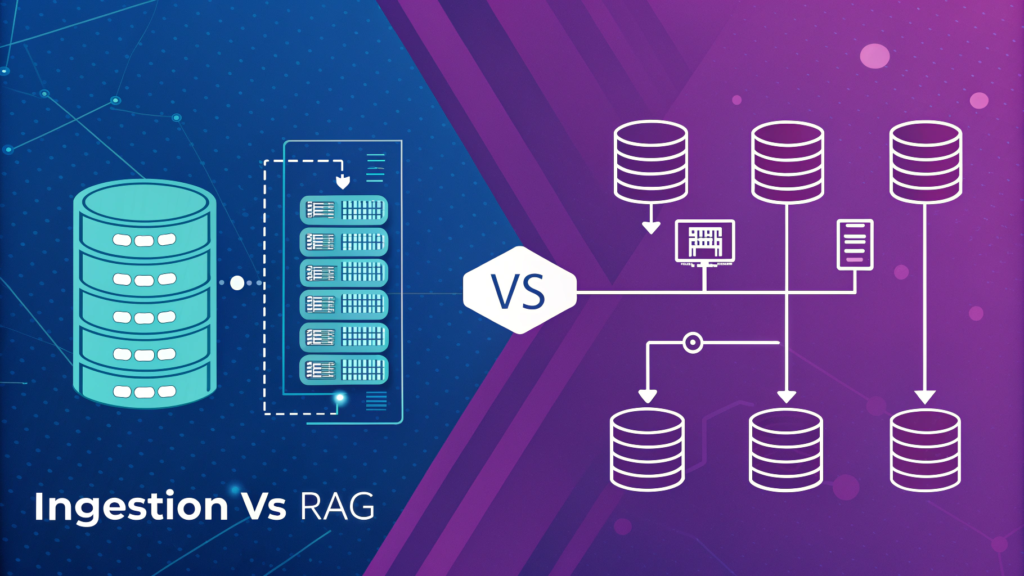
To grasp this transformation, it helps to map traditional search concepts directly to their AI equivalents:
| Traditional Search Engine | AI-Powered Systems | Key Difference |
|---|---|---|
| Crawl | Ingestion | Google continuously crawls the web; AI selectively ingests content from websites, documents, or other sources. |
| Index | Embeddings + Vector Index | Traditional indexing is keyword-based; AI embeddings capture semantic meaning in vector form. |
| Rank | Retrieval Scoring | Google ranks entire pages; AI ranks content chunks based on semantic similarity to queries. |
| SERP | RAG Output (Answer) | Google shows a list of links; AI generates synthesized answers, often with citations. |
Let’s break down what each of these means in practice.
In the traditional search model, Google’s process follows a well-established pattern:
1. Crawling: Googlebot systematically visits web pages, following links across the internet. It’s an ongoing, automated process that discovers new content and updates existing content in Google’s systems.
2. Indexing: Once crawled, pages are analyzed and stored in Google’s massive index. The index organizes content by keywords, metadata, and hundreds of other signals that help determine relevance.
3. Ranking: When someone searches, Google’s algorithms evaluate billions of pages and rank them based on relevance, authority, freshness, user experience, and countless other factors. The goal is to present the most useful pages.
4. SERP Display: The output is a Search Engine Results Page—a list of links to websites ranked by their perceived value to the searcher. Users click through to read the full content on the original site.
Key characteristic: Traditional search ranks entire pages and sends users to websites. Visibility depends on how well your page performs against ranking algorithms.
AI-powered search and assistant systems operate fundamentally differently:
1. Ingestion: Rather than continuously crawling the open web, AI systems ingest selected content sources. This might include licensed datasets, web snapshots, API-connected knowledge bases, or real-time search results. The ingestion is more selective and purposeful than traditional crawling.
2. Embeddings + Vector Index: Once ingested, content isn’t simply stored as text. It’s broken into smaller semantic chunks—paragraphs, sections, or concepts—and each chunk is converted into a vector embedding. These embeddings are mathematical representations that capture the meaning and context of the content, not just keywords. These embeddings are stored in a vector database that enables semantic search.
3. Retrieval Scoring: When a user asks a question, the AI doesn’t rank entire pages. Instead, it searches the vector index for content chunks that are semantically similar to the query. The system retrieves the most relevant pieces of knowledge based on meaning, not keyword matching.
4. RAG Output (Answer): Using Retrieval-Augmented Generation, the AI takes the retrieved content chunks and synthesizes them into a direct answer. The user gets information immediately, often with citations to sources, but rarely needs to click through to a website.
Key characteristic: AI systems retrieve knowledge fragments and generate answers. Visibility depends on whether your content can be accurately ingested, chunked, and retrieved when relevant.
The implications of this shift are profound:
Traditional search optimization aimed to rank high enough to earn clicks. AI optimization must ensure your content is structured so it can be retrieved and cited as a source—even if users never visit your site.
Google’s algorithms have evolved to understand semantics, but they still rely heavily on keyword signals and link authority. AI embeddings are built purely on semantic meaning. Two pieces of content might use completely different words but be considered highly similar if they convey the same concepts.
Traditional SEO thinks in terms of pages. AI ingestion thinks in terms of knowledge units. A single page might contain multiple retrievable chunks, or a key insight buried in a long article might be extracted and used independently.
With traditional search, you compete for positions one through ten. With AI systems, you compete to be retrieved as the most semantically relevant source. There’s no visible ranking—either your content gets pulled into the answer or it doesn’t.
This shift means content strategy must evolve. While traditional SEO remains important for web traffic, optimizing for AI ingestion requires different thinking—something we focus on extensively in our AI SEO services:
We’re currently living in a hybrid world. Traditional search engines still drive significant traffic, but AI-powered systems are rapidly gaining adoption. Content creators face the challenge of optimizing for both paradigms simultaneously.
The good news is that many principles of quality content remain constant: accuracy, clarity, authority, and usefulness matter whether you’re targeting Google’s algorithms or AI embeddings. But the technical implementation—how you structure, markup, and present that content—must now account for both page-level ranking and chunk-level retrieval.
The evolution from crawling to ingestion represents more than a technical change in how machines process content. It’s a fundamental shift in how knowledge is discovered, extracted, and delivered to users. Understanding that AI systems don’t rank pages but retrieve knowledge is the first step toward remaining visible in an AI-first information landscape.
As AI systems become the primary gateway to information for more users, optimizing for ingestion isn’t optional—it’s essential. The question isn’t whether to adapt, but how quickly you can evolve your content strategy to serve both traditional search engines and the AI systems that are increasingly mediating how people find answers.
At Rankedge, we’re helping businesses navigate this transition by combining traditional SEO expertise with cutting-edge AI SEO strategies to ensure your content remains discoverable in both paradigms.
What Next
Tell us what you are trying to grow and we will tell you honestly whether we are the right people for it.