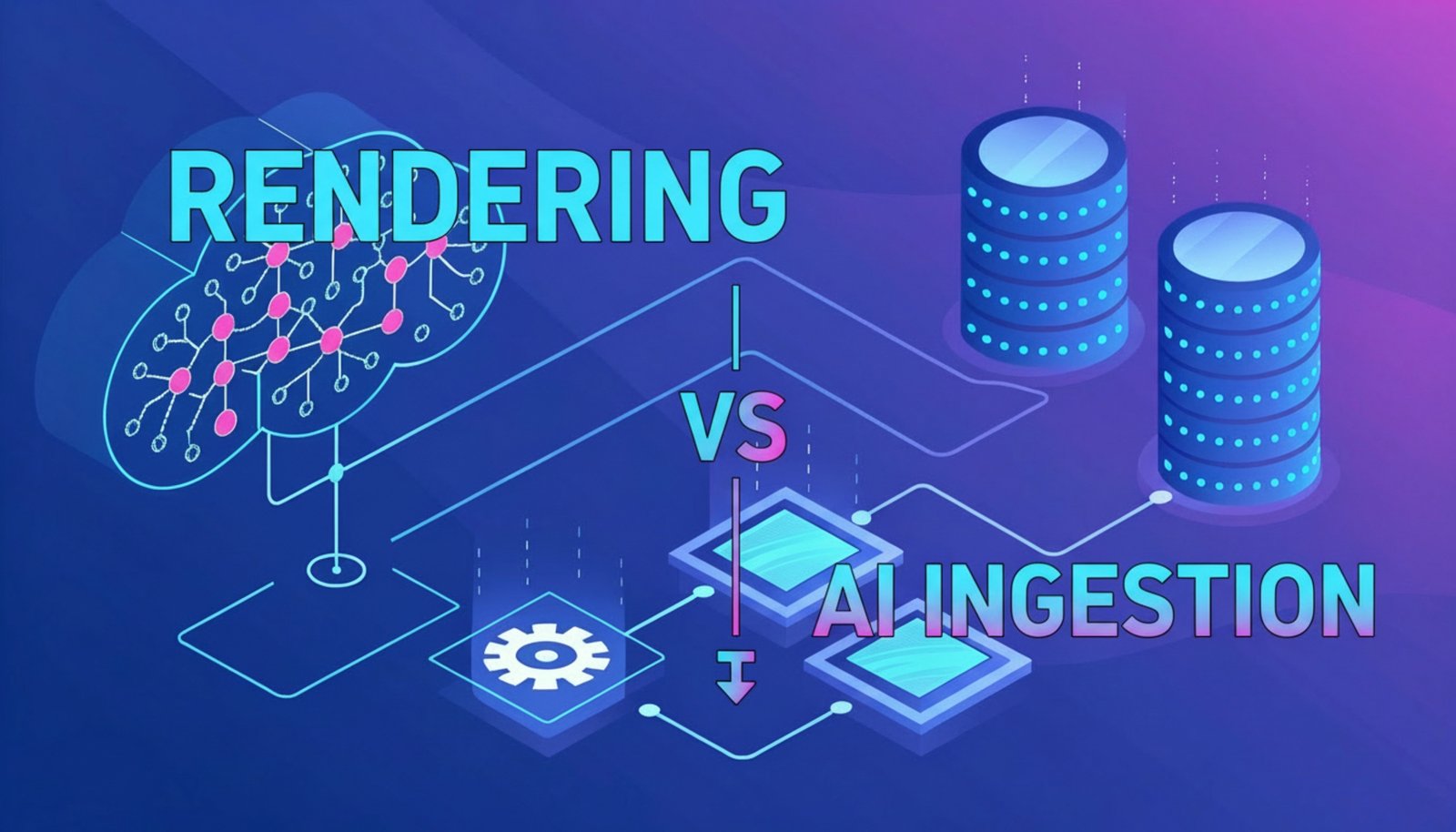
Content visibility in 2026 requires mastering two distinct processes: rendering and AI ingestion. Rendering determines whether search engines can technically see your content, while AI ingestion determines how both search engines and AI assistants understand, store, and retrieve that content as knowledge. Success requires content that is both technically renderable and semantically ingestible.
Understanding Rendering: Making Content Visible
Rendering is the process crawlers use to transform raw HTML and JavaScript into a visually complete page, similar to what humans see in browsers. Modern search engines increasingly use headless Chrome to evaluate layout, hidden elements, and user experience signals.
How Rendering Works
Search engines follow a specific pipeline when rendering content. First, bots crawl URLs starting from sitemaps and links, prioritizing pages that are fast and accessible. Next, HTML is parsed immediately, followed by a rendering stage that executes JavaScript to discover additional content, links, and user experience issues.
Critical Rendering Constraints
Static HTML receives priority in crawling and indexing. This means critical content should appear in source code rather than loading only after JavaScript execution or user interactions. Heavy client-side rendering or AJAX-loaded sections like reviews, specifications, and comments may be partially rendered or never indexed, significantly reducing ranking potential.
Understanding AI Ingestion: Creating Semantic Knowledge
AI ingestion represents how modern AI search engines and large language models read, tokenize, encode, and store content as vectors for future retrieval and generation. Rather than matching keywords, these systems map entities, relationships, and contextual meaning to answer natural language questions using your content as a source.
How AI Ingestion Works
AI systems use natural language processing, transformer models like BERT and MUM, and embeddings to understand meaning and intent beyond text strings. Your site becomes an entity within a knowledge graph, with topical focus, authority, and brand signals determining whether your page gets cited in AI responses.
AI Ingestion Priorities
AI systems perform entity and topic mapping by identifying brands, products, problems, and methods, then anchoring content within topical clusters. Contextual ranking replaces keyword density, using signals like coverage depth, coherence, user engagement, and external mentions to determine retrieval worthiness.
Key Differences Between Rendering and AI Ingestion
| Aspect | Rendering (SEO) | AI Ingestion |
|---|---|---|
| Purpose | To display the page as a user would, so search engines can index and rank it | To understand the meaning and semantics of content for retrieval, recommendations, or AI reasoning |
| Process | Fetch HTML → Execute JavaScript → Build DOM → Apply CSS → Extract content | Ingest text or structured content → Tokenize → Convert to vectors/embeddings → Store semantic meaning |
| Execution of JavaScript | ✅ Yes, often necessary for modern pages | ❌ No, AI systems do not execute JavaScript |
| Content Representation | Final rendered HTML content, visible text, links, metadata | Vectors (embeddings) representing meaning and context |
| Focus | Visibility, correctness, and layout of content | Semantic understanding and relationships between concepts |
| Dependency on Layout/Styling | High — CSS and DOM structure can affect what is seen | Low — AI ignores visual layout; only text/semantic meaning matters |
| Indexing/Storage | Indexed in traditional search engine index for ranking | Stored as embeddings in a vector database or knowledge system |
| Common Tools | Googlebot, Bingbot, headless browsers (Chromium) | LLMs, vector databases, AI ingestion pipelines |
| Impact of Missing Content | Critical — unseen content may not be indexed | Partial — missing layout does not affect understanding if text is available |
| Output | Rendered page snapshot with extracted content ready for ranking | Semantic vector representation ready for search, QA, or AI reasoning |
Technical Best Practices for Rendering
Optimize your site’s technical foundation to ensure search engines can fully render and index your content.
Server-Side Rendering Strategy
Prefer server-side rendering or hybrid approaches for critical content so it appears in HTML source code. This ensures immediate crawlability without relying on JavaScript execution.
Avoid AJAX Dependencies
Do not rely solely on AJAX or user interactions for important text like product details, FAQs, or case studies. Duplicate summaries in static HTML when necessary to guarantee indexation.
Performance Optimization
Prioritize Core Web Vitals optimization. Slow or script-heavy pages are less likely to be fully rendered or revisited frequently by crawlers, directly impacting your indexation potential.
Content Accessibility
Place primary copy, headings, and links in initial HTML whenever possible. Avoid hiding them behind tabs, infinite scroll, or post-load AJAX calls that may never be discovered.
Content Best Practices for AI Ingestion
Structure your content to maximize understanding and retrieval by AI systems.
Topic Cluster Architecture
Organize content into clear topic clusters with strategic internal links. This helps both search engines and AI systems infer your site’s core expertise and topical authority.
Semantic Clarity
Use descriptive headings, schema markup, and consistent terminology to clarify entities and relationships. This increases chances of retrieval and citation in AI-powered responses.
Entity Definition
Clearly define key entities including brands, products, problems, and solutions. AI systems use these entities to anchor your content within knowledge graphs and determine relevance for specific queries.
Contextual Depth
Provide comprehensive coverage of topics rather than surface-level overviews. AI systems evaluate depth of coverage, coherence, and expertise signals when deciding which sources to cite.
Integrated Optimization Strategy
Winning visibility in 2025 requires simultaneous optimization for both rendering and AI ingestion.
Content Creation Workflow
Begin with clear semantic structure and entity definitions that AI systems can easily parse. Then ensure this content appears in crawlable HTML that search engines can efficiently render.
Quality Signals
Focus on signals that matter to both systems: fast loading times benefit rendering, while comprehensive coverage and clear structure benefit AI ingestion. User engagement metrics influence both.
Authority Building
Establish topical authority through consistent focus, external mentions, and brand signals. This affects both traditional ranking algorithms and AI system decisions about citation worthiness.
Technical Maintenance
Regularly audit both rendering performance and semantic clarity. Use tools to verify that critical content appears in rendered output and that entity relationships are clearly expressed.
Conclusion
Content success in the age of AI requires understanding and optimizing for two distinct but complementary processes. Rendering ensures search engines can technically access and index your content through proper HTML structure and performance optimization. AI ingestion ensures AI systems can semantically understand, store, and retrieve your content through clear entity definitions, topic clustering, and contextual depth.
By aligning technical structure with semantic clarity, you create content that succeeds in both traditional search rankings and AI-powered discovery systems. The future of content visibility depends on mastering both rendering and ingestion, ensuring your content is not only seen but truly understood and valued by the systems that connect users with information.